
A Profile in Leadership: Dr. Lizbeth Vargas Castillo and NCD Initiatives at AMPATH/MAPAS México
Dr. Lizbeth Vargas Castillo is a recent medical graduate from Benemérita Universidad Autónoma de Puebla (BUAP) with additional training as an Emergency Medical Technician, but her devotion to learning and community building is far from over. Now working as a general practitioner within the AMPATH/MAPAS México partnership that cultivated her career, she finds new ways to contribute to long-term health outcomes while growing herself as an interdisciplinary servant leader.
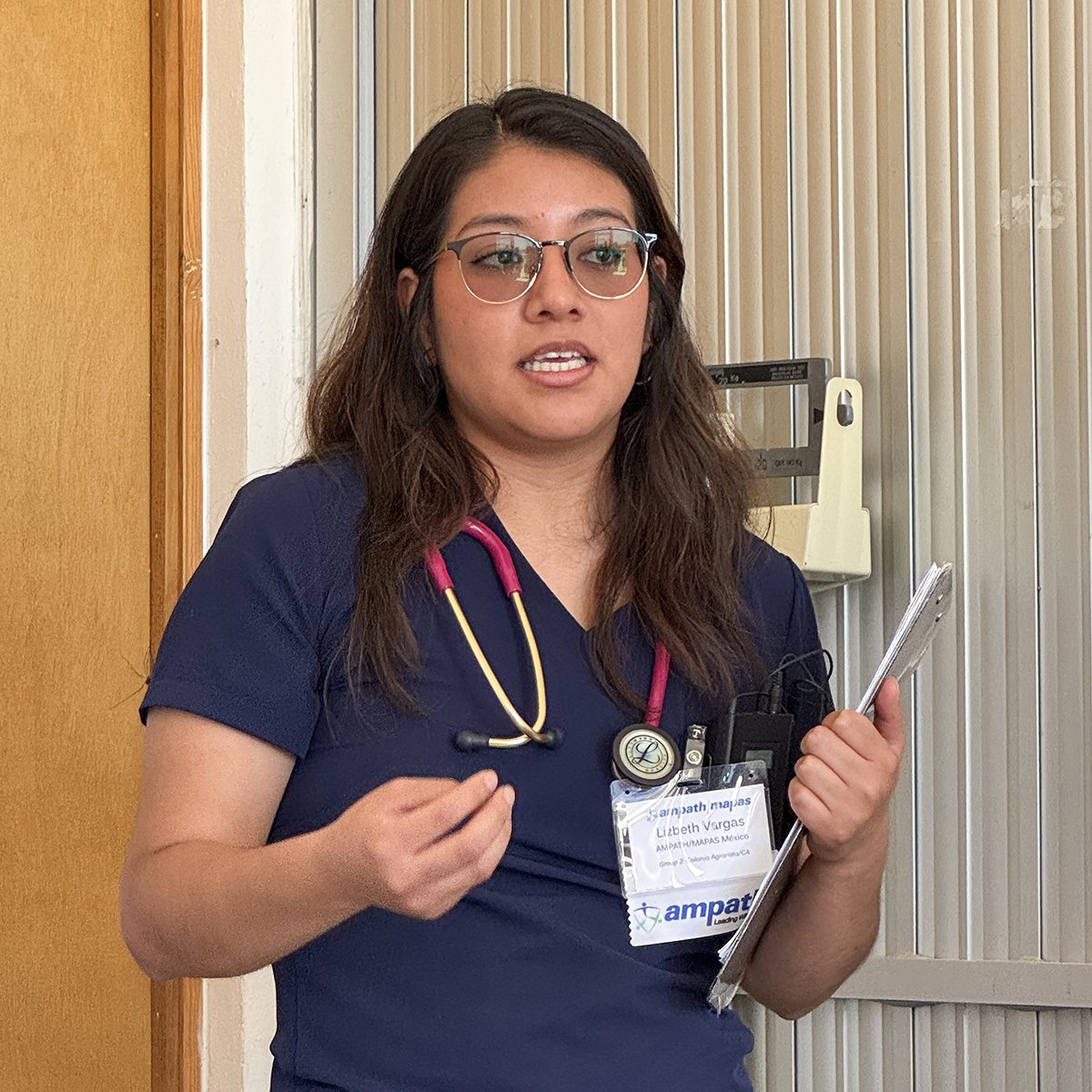
Dr. Lizbeth Vargas Castillo
“During my time as a pasante (medical student in her social service year), I learned a lot about medicine, but I learned even more about myself,” Dr. Vargas said. “I discovered that I deeply enjoy the close contact with patients: understanding their lifestyle, their context and history, in order to adapt care in an individualized and realistic manner. I confirmed also that I am passionate about health education, especially when it’s achieved in a form that’s simple and accessible.”
In her new role, Dr. Vargas is part of the continued development of the care programs launched when she was still a student. She moves expertly between the clinical operations of health activities, home visits, workshops, medical outreach events and the guidance, support and training of pasantes. It’s easy to see how a thoughtful listener such as Dr. Vargas – with her wide smile and studious glasses – builds valued trust not just with students, peers and mentors at BUAP, but in the far-flung rural communities surrounding Puebla.
Since its formal launch in 2018 as one of three new AMPATH Global locations, the AMPATH/MAPAS México partnership has nurtured a collaboration between BUAP, The University of Texas at Austin and the AMPATH Consortium of 16 other academic health centers around the world.
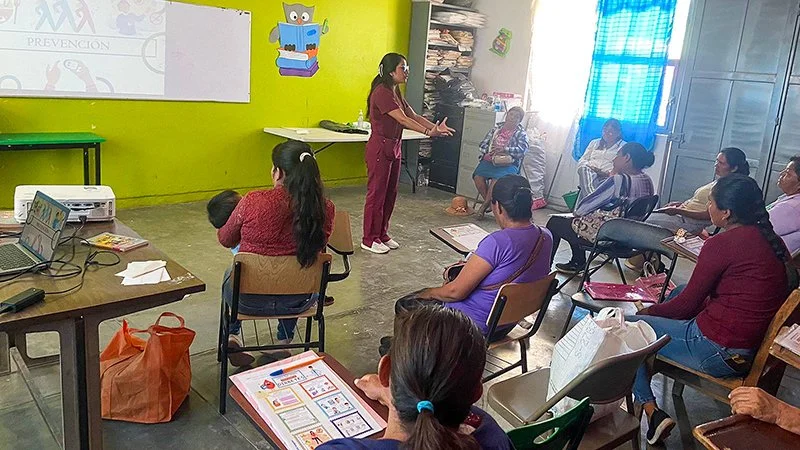
Dr. Vargas leads a training session
A donation from Eli Lilly and Company to Indiana University Foundation supports efforts related to supporting AMPATH’s efforts to build community capacity and strengthen health systems for non-communicable diseases in rural, resource-limited communities in Puebla, Mexico.
Through its Access to Health commitment, Astellas also supports AMPATH/MAPAS México with a donation to strengthen cancer prevention and early detection in Puebla’s underserved communities.
AMPATH/MAPAS México seeks to break down barriers to healthcare access and transform population health in the Puebla region, neighboring Texas communities and beyond. Its cross-border focus areas include care, education and research in holistically addressing the needs of patients with non-communicable diseases (NCDs), building systems for community-based health outreach, and strengthening support for pasantes and primary care providers working in resource-limited areas.
Dr. Vargas likened AMPATH’s function to that of a family: everyone is in it together for a longer journey. “It has a deeply collaborative focus, based on respect for the communities and in the construction of trusting relationships,” Dr. Vargas said. “It’s not a one-off project, but an effort of continuous follow-up, with a vision and long-term plans oriented toward generating a real and sustainable impact in community health.”
One such critical effort is a new NCD database, tracking contact information and histories of patients with conditions such as prediabetes, diabetes, hypertension, obesity and heart disease. Dr. Vargas explained how this data – gathered from health outreach events and home visits – has expanded and enhanced patient care in the target communities, saving time during visits and allowing for analysis and individualized planning in advance of appointments.
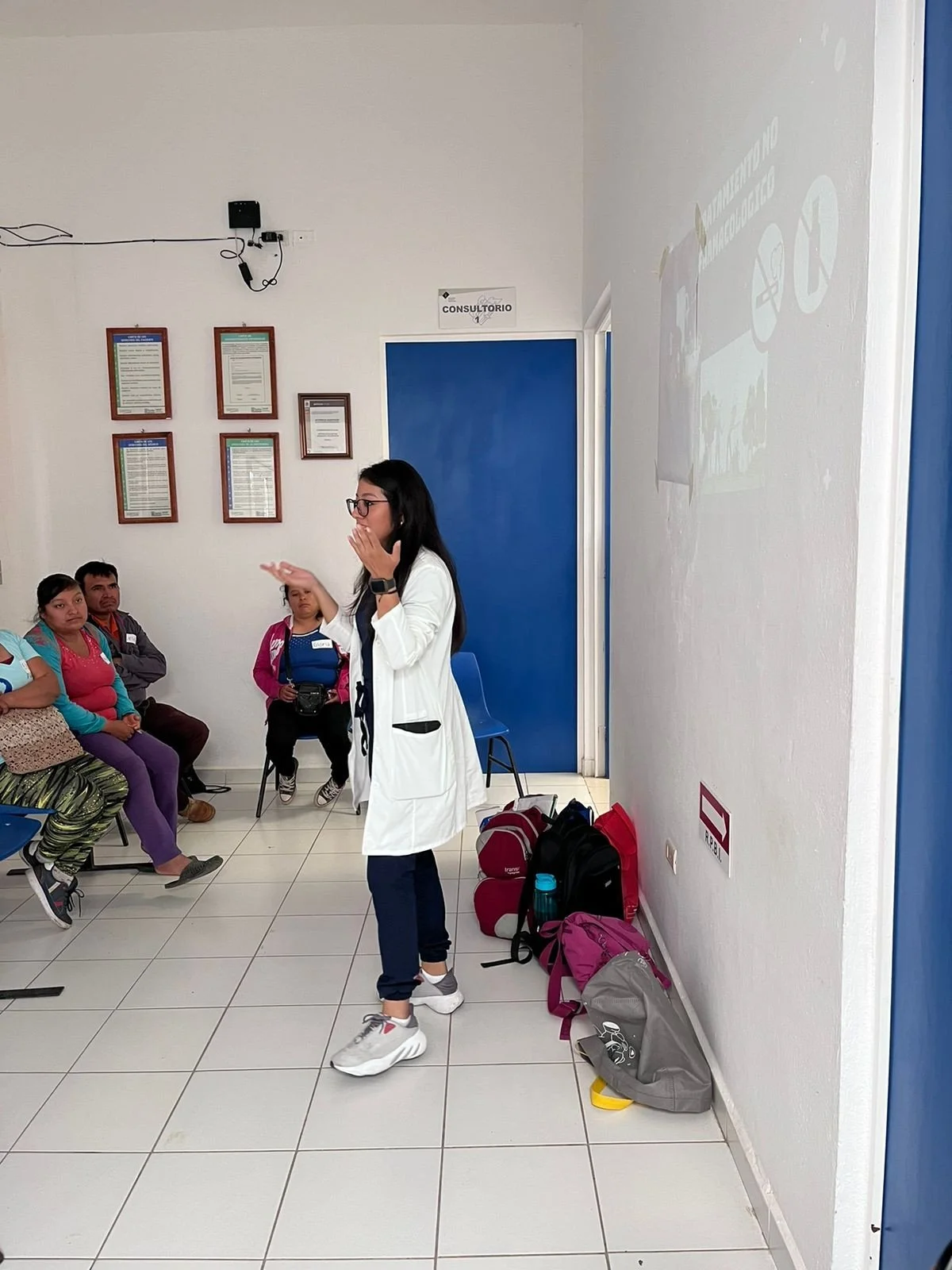
Dr. Vargas providing health information in the community
“This also builds trust with patients, as they perceive that we are familiar with their medical history, previous treatments, and comorbidities, which strengthens the doctor-patient relationship,” she said. “We have had several success stories, but one that I have been particularly involved with recently is that of an elderly woman with a visual impairment who initially attended one of our medical clinics. After analyzing the database and prioritizing the patients who required follow-up care, we identified the need to provide her with more continuous support.”
“Furthermore, when patients trust the team, they often recommend us to others in the community, which allows us to expand our reach and get to more homes,” she continued. “This reinforces the value of consistent and close-knit work in the field.”
Beyond patient care, the developing database will also support thoughtful implementation of improved health education and research-informed initiatives. To sustain these efforts, pasantes with AMPATH/MAPAS train local promotores comunitarios de salud (community-based health promoters). Dr. Vargas, who was a student leader when the training program launched, said that working with promotores has been one of the most humbling and enriching experiences of her professional training.
“I have been able to confirm that talent, commitment and leadership skills can emerge in any context, and that often they only need the right support and opportunity to develop,” she said. “Seeing the commitment they have built with the project and how they share what they have learned with their community is deeply inspiring. Their participation demonstrates that health knowledge can be multiplied when it is transmitted by people who know and live the reality of the community.”
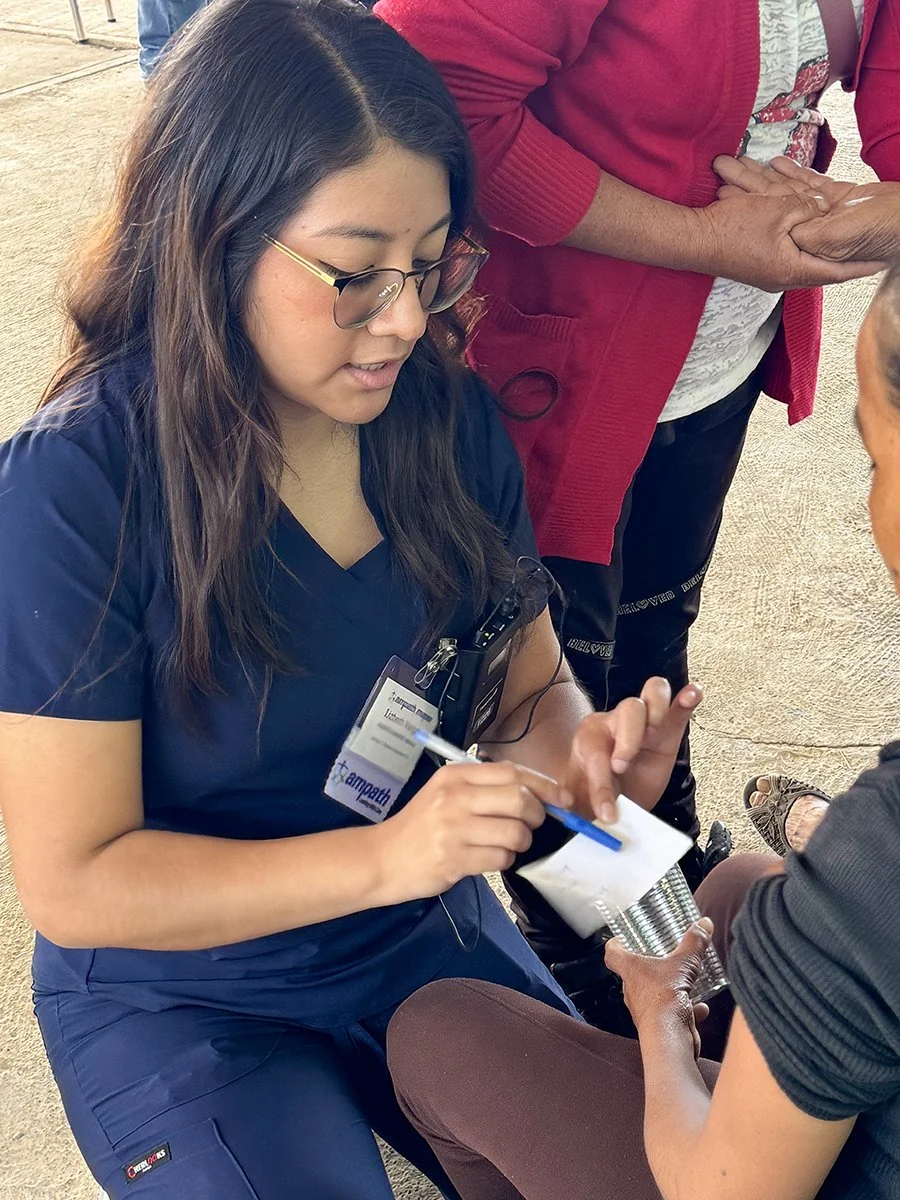
Dr. Vargas gives instructions to a community member at a community screening event
Together, pasantes and promotores aim to design innovative and effective health interventions with far-reaching impact – from high-quality community-based care models, to longitudinal studies, to training for more local health workers. These interventions, woven into Mexican standard clinical guidelines, would adapt to different levels of literacy and need, empowering communities to participate actively and take ownership of their approach to health.
But building a comprehensive NCD database rooted in community trust is not without challenges. Dr. Vargas identified ongoing hurdles: from organizing large volumes of information and translating them into practical decisions, to the need for standardized training guides for pasantes, to continuing close and comprehensive follow-up care for all patients, and finally, to maintaining the promotores team.
“Most are women who, in addition to their participation in the project, have responsibilities in the fields, at home, with their families and animals, which sometimes makes it difficult for them to attend regularly or leads them to consider leaving the project,” she said. “Added to this is the constant need for training and support.”
“However, the achievements far outweigh the difficulties. Among the greatest successes, the role of the promotoras has been consolidated and made more visible within the community, sparking the interest of others to participate. This allows health information to be disseminated more widely and, over time, contribute to improving community health,” Dr. Vargas continued.
Between seeing patients in remote areas, training a rising generation of Mexican physicians, and working on the NCD database, Dr. Vargas is well-balanced between the three AMPATH pillars of care, education and research. She’s currently completing a diploma program in ultrasound and recently traveled to Atlanta to present at the annual conference for the Consortium of Universities for Global Health (CUGH). And she is eager to strengthen her contributions with reciprocal learning alongside a new crop of pasantes graduating in February 2026, promotores in the communities, and her own mentor Dr. Rebecca Cook.
“I’m interested in continuing to combine clinical practice with social impact projects, health education and research,” Dr. Vargas said, “understanding medicine as not just about individual care, but as a tool to improve collective health.”
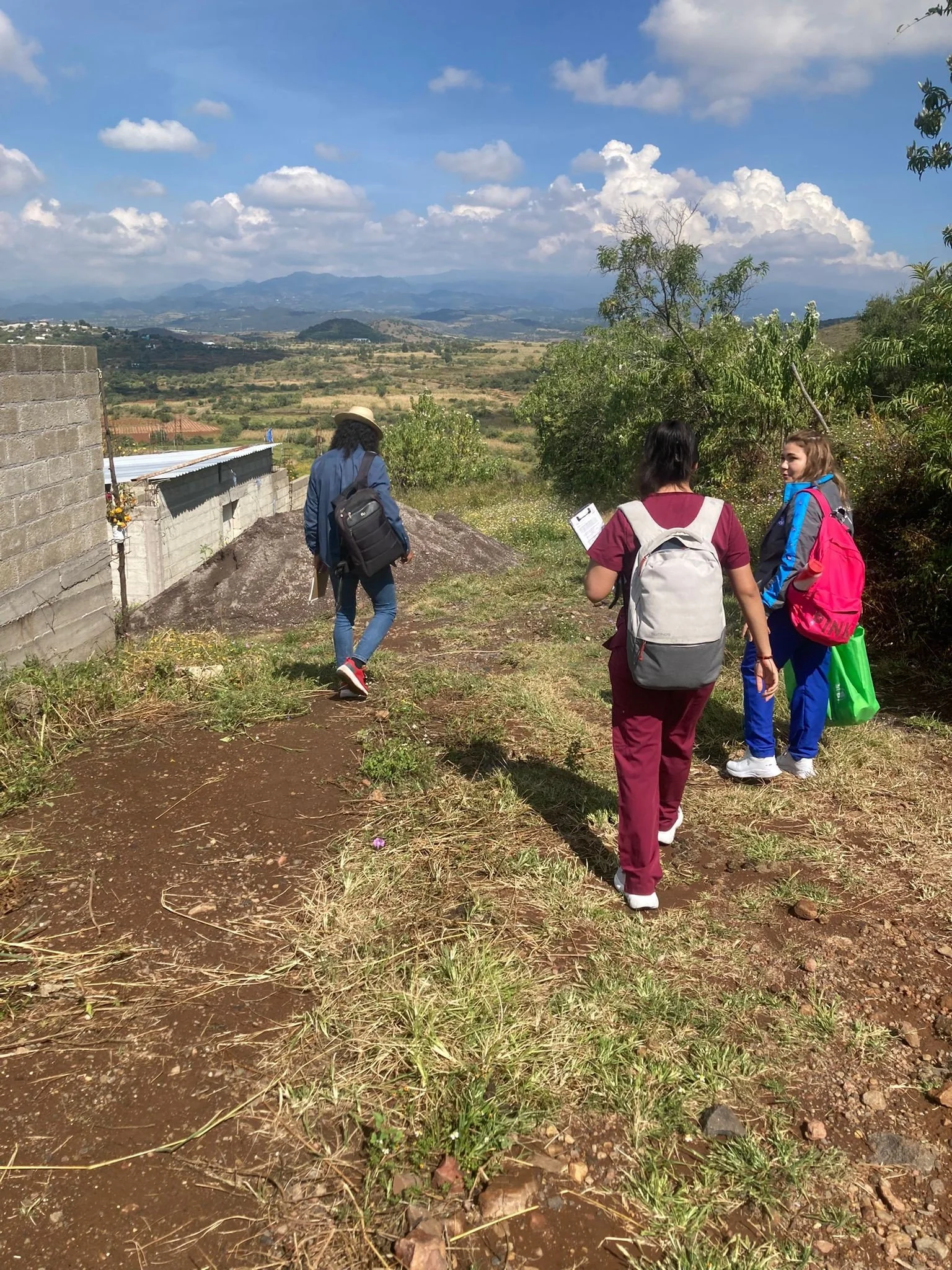
Heading to a home visit
“One of the greatest joys as a medical educator is having one of my former trainees return to help lead our clinical program,” said Dr. Cook, who serves between UT Dell Med and BUAP as partnership director and clinical lead for AMPATH/MAPAS México. “Having a recent graduate of the medical school help mentor trainees has been a great addition to our care program. And at the community level, both our patients and the promotoras we mentor are deeply grateful to have the continuity and commitment of a local medical doctor who will continue with them, as trainees may cycle through.”
In September 2025, with the illuminated UT Tower in the background, Cook and Vargas took the stage at the AMPATH Global Gathering in Austin, sharing the serendipitous story that brought them – and especially Dr. Vargas – together to a higher calling of community service and personal learning.
“The truth is, I think it was destiny,” Dr. Vargas told the audience with a laugh. “AMPATH was actually my second choice for social service year! But destiny, luck, future – I don’t know what it was. I just know I found my place. AMPATH has been significant for me, personally and professionally.”